
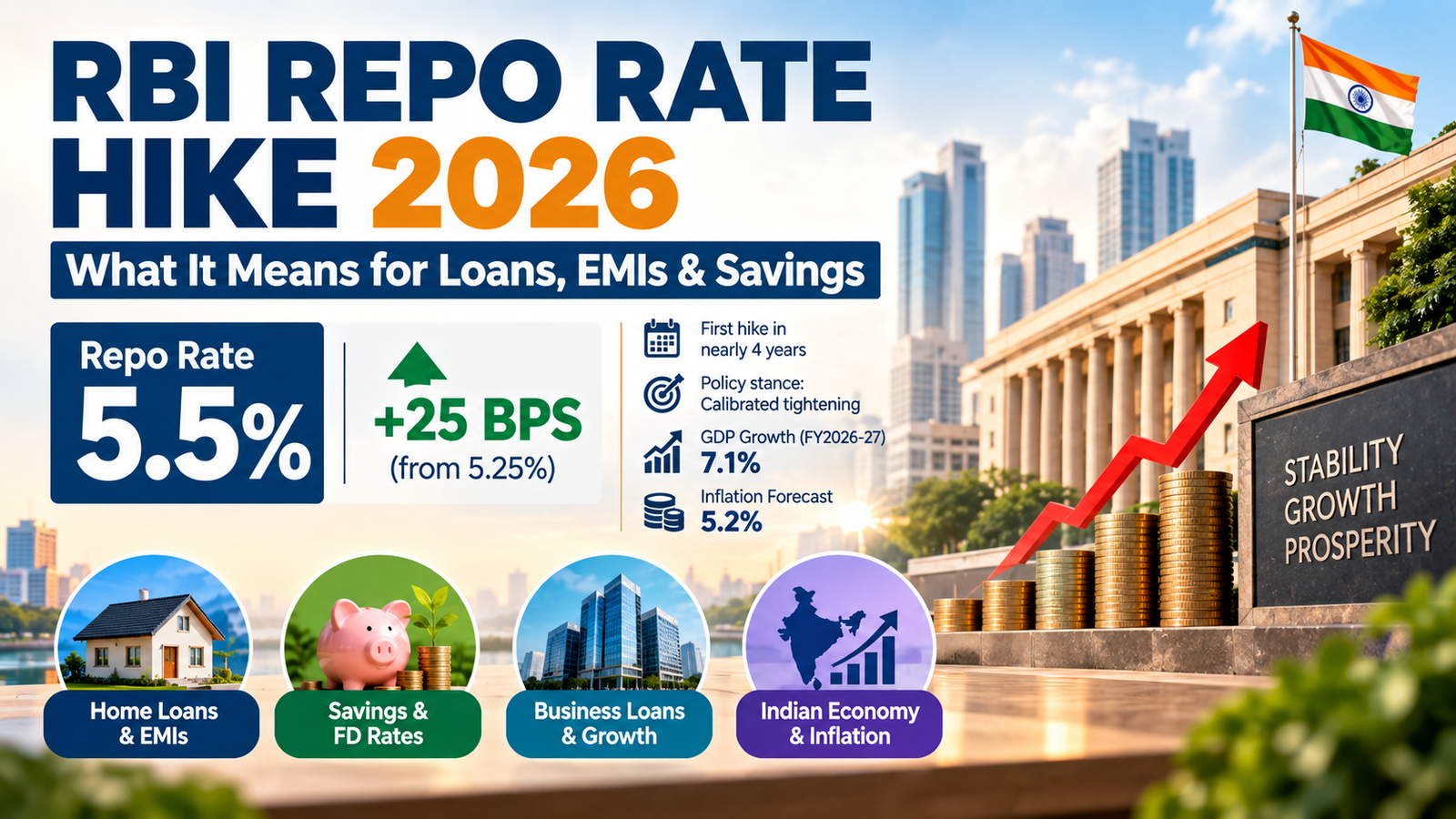
RBI repo rate hike 2026 has become a major financial development for Indian borrowers and savers. The Reserve Bank of India (RBI) raised the policy repo rate by 25 basis points to 5.50% on October 7, 2026, marking the first rate hike since February 2023.
The RBI's Monetary Policy Committee (MPC) also changed its policy stance from neutral to calibrated tightening. The decision comes as inflation risks have increased because of higher crude oil prices, food-price pressures, weather-related risks and global economic uncertainty.
For households, the key question is what this means for home loans, EMIs, personal loans, car loans, fixed deposits and savings. Here is a simple explanation of the RBI's latest decision and what consumers should watch next.
RBI Repo Rate Hike 2026: What Was Announced?
The RBI raised the policy repo rate by 25 basis points, taking it from 5.25% to 5.50%.
| Key RBI decision | October 2026 update |
|---|---|
| Policy repo rate | 5.50% |
| Rate increase | 25 basis points |
| Previous repo rate | 5.25% |
| Previous hike | February 2023 |
| Policy stance | Calibrated tightening |
| FY2026-27 GDP forecast | 7.1% |
| FY2026-27 inflation forecast | 5.2% |
The six-member MPC voted unanimously in favour of the 25-basis-point rate increase. The change in policy stance to calibrated tightening was approved by a majority of 4-2, according to reporting on the October policy decision.
Reuters reported on the RBI's October 2026 rate decision.
What Is the RBI Repo Rate?
The repo rate is the interest rate at which the Reserve Bank of India lends short-term funds to banks against eligible securities.
When the RBI changes the repo rate, it can influence the cost of funds across the banking system. Banks may then adjust lending and deposit rates depending on their funding costs, competition and other market conditions.
This means a repo rate increase does not automatically mean that every loan interest rate will rise by exactly 0.25 percentage points. The actual impact depends on the bank, loan type, benchmark and timing of the rate reset.
Why Did the RBI Raise the Repo Rate in 2026?
The RBI's latest decision comes against a background of renewed inflation risks and strong economic activity.
1. Higher crude oil prices
International crude oil prices have risen sharply amid geopolitical tensions. Because India imports a large share of its crude oil requirements, higher oil prices can increase costs across transportation, manufacturing and other parts of the economy.
2. Inflation risks
The RBI raised its FY2026-27 inflation projection to 5.2%. The central bank is also monitoring food prices, fuel costs and the possibility that temporary price increases could become broader inflationary pressure.
3. Weather and food-price risks
Uneven monsoon conditions and weather-related risks could affect agricultural production and food prices. This creates another source of uncertainty for India's inflation outlook.
4. Strong economic growth
The RBI has also raised its FY2026-27 real GDP growth forecast to 7.1% from 6.7% previously. Stronger economic activity gives the central bank more room to focus on controlling inflation even while maintaining a positive growth outlook.
RBI Repo Rate Hike 2026: What Happens to Home Loan EMIs?
Home-loan borrowers are among the people most interested in the latest RBI decision.
For borrowers whose loans are linked to an external benchmark such as the repo rate, a change in the benchmark can affect the interest rate when the loan resets. However, the exact timing and size of the change depend on the lender and the loan agreement.
For example, if a bank passes on the full 25-basis-point increase to an eligible floating-rate loan, the interest rate could rise by 0.25 percentage points.
That does not necessarily mean the EMI will increase immediately by a fixed amount. Depending on the loan structure, the bank may adjust the EMI, extend the repayment period, or use another permitted method.
Example of a Home Loan Impact
Suppose a borrower has a floating-rate home loan of ₹50 lakh. A 0.25 percentage-point increase in the interest rate can increase the overall interest burden if the higher rate remains in place for the rest of the loan period.
The exact EMI impact depends on the outstanding principal, remaining tenure and current interest rate. Borrowers should therefore check their bank's revised rate rather than relying on a generic EMI estimate.
What Happens to Personal and Car Loans?
Personal loans and vehicle loans can also be affected by changes in the broader interest-rate environment.
However, the effect will depend on whether the loan is fixed-rate or floating-rate and how the lender prices the product.
- Floating-rate loans: May become more expensive when the applicable benchmark rises.
- Fixed-rate loans: Usually remain unchanged during the fixed-rate period.
- New loans: Banks may review lending rates for new customers.
- Existing loans: The impact depends on the loan agreement and reset mechanism.
Will Fixed Deposit Rates Increase After the RBI Rate Hike?
Higher policy rates can create an opportunity for banks to offer better deposit rates, particularly when banks need more deposits to support credit growth.
However, a repo rate hike does not guarantee an immediate increase in every fixed deposit rate.
FD rates depend on each bank's funding requirements, liquidity conditions, competition and expectations about future interest rates.
Savers should therefore compare current FD rates instead of assuming that every bank will increase rates by 25 basis points.
What Does the RBI Decision Mean for Borrowers?
The immediate message for borrowers is that the era of falling interest rates may be taking a pause.
The shift to calibrated tightening suggests that the RBI is now more focused on inflation risks. The central bank has indicated that future decisions will depend on incoming inflation and growth data.
Borrowers should therefore avoid assuming that loan rates will fall again in the short term.
Existing Borrowers Should Check These Things
- Current loan interest rate
- Loan benchmark or reset mechanism
- Next interest-rate reset date
- Outstanding principal
- Remaining loan tenure
- Whether EMI or tenure changes after a rate revision
What Does It Mean for People Planning a New Loan?
If you are planning to take a home, car or personal loan, the October 2026 rate hike is a reason to compare offers carefully.
Instead of looking only at the advertised interest rate, borrowers should compare the total cost of borrowing, processing fees, reset frequency, prepayment conditions and other charges.
A small difference in interest rates can become significant over a long repayment period, especially for large home loans.
RBI Inflation Forecast Raised to 5.2%
The RBI has raised its FY2026-27 inflation projection to 5.2%.
Reuters reported that the central bank expects headline inflation to average around 5.8% over the next three quarters, while core inflation is projected at around 4.4% for FY2026-27.
August consumer inflation was reported at around 4.82%, remaining above the RBI's 4% medium-term target.
The inflation outlook is therefore one of the main reasons the central bank has adopted a tighter policy stance.
Economic Times explained the key takeaways from the October 2026 RBI MPC meeting.
India's FY2026-27 GDP Growth Forecast Raised to 7.1%
Despite the rate hike, the RBI remains positive about India's economic growth.
The central bank raised its FY2026-27 real GDP growth projection from 6.7% to 7.1%.
This suggests that the RBI sees domestic economic activity as resilient enough to handle somewhat tighter financial conditions while the central bank focuses on inflation risks.
Strong services activity, manufacturing, domestic demand and investment have supported the growth outlook, although global uncertainty and higher commodity prices remain risks.
RBI Policy Stance Changes to Calibrated Tightening
One of the most important parts of the October 2026 announcement is the change in the policy stance.
The RBI moved from neutral to calibrated tightening.
This does not mean that another rate hike is guaranteed. Instead, it signals a stronger focus on controlling inflation and leaves the door open for further tightening if economic conditions require it.
Governor Sanjay Malhotra indicated that future policy action would depend on actual inflation, growth and the broader economic outlook.
Could the RBI Hike Rates Again?
Another rate hike is possible, but it should not be treated as certain.
The RBI has indicated that future decisions will depend on inflation trends, economic growth, commodity prices, geopolitical developments and other incoming data.
For consumers, the practical takeaway is that borrowers should not build their financial plans on the assumption that interest rates will quickly return to lower levels.
Who Could Benefit From the RBI Rate Hike?
Not everyone is negatively affected by higher interest rates.
- Existing savers: May benefit if banks increase deposit rates.
- New FD investors: Could get better rates if banks reprice deposits upward.
- Conservative investors: Higher deposit yields may improve returns from some fixed-income products.
However, the actual benefit depends on how banks adjust their deposit rates and how long higher rates remain in place.
Who Could Be Most Affected?
- Floating-rate home-loan borrowers
- People planning large new loans
- Businesses dependent on bank borrowing
- Consumers with variable-rate personal or vehicle loans
- Companies facing higher financing costs
What Should Borrowers Do Now?
The RBI repo rate hike does not mean borrowers need to panic. Instead, it is a good time to review your existing debt.
- Check your latest loan interest rate.
- Find out which benchmark your loan follows.
- Check the next reset date.
- Compare your lender's current rates with competing banks.
- Avoid taking unnecessary high-cost debt.
- Maintain an emergency fund before making large financial commitments.
- If you have a long-term loan, consider how a higher rate could affect your total interest cost.
What Should Savers Do?
Savers should compare FD and savings rates across banks instead of automatically moving money after a single rate announcement.
If you are considering an FD, compare the interest rate, tenure, premature-withdrawal rules, payout frequency and the bank's deposit terms.
For larger deposits, also consider how your overall savings are distributed rather than focusing only on the highest advertised rate.
RBI Repo Rate Hike 2026: Key Numbers at a Glance
| Indicator | Latest update |
|---|---|
| Repo rate | 5.50% |
| Increase | 25 bps |
| Previous repo rate | 5.25% |
| Previous RBI hike | February 2023 |
| Policy stance | Calibrated tightening |
| FY2026-27 GDP forecast | 7.1% |
| FY2026-27 inflation forecast | 5.2% |
What This Means for the Indian Economy
The RBI is trying to balance two competing objectives: maintaining strong economic growth while preventing inflation from becoming more persistent.
The higher repo rate can help moderate demand and inflationary pressure, but it can also make borrowing more expensive for consumers and businesses.
At the same time, the RBI's higher 7.1% FY2026-27 GDP forecast shows that the central bank continues to see significant underlying strength in the Indian economy.
The coming months will therefore be important for watching crude oil prices, food inflation, monsoon conditions, global financial markets and domestic economic activity.
Related Guides from WriteHubDaily
If you are following India's economy, household expenses and business trends, these WriteHubDaily guides may also be useful:
- India Tech Funding 2026: Startups Raise $10.3 Billion in Nine Months
- AC Price Hike 2026: TV & Washing Machine Prices Rise
- Small Business Productivity Tips
- How AI Can Help Small Businesses Save Time and Money
- How to Be More Productive: 10 Simple Habits That Actually Work in 2026
Frequently Asked Questions
What is the RBI repo rate in October 2026?
The RBI policy repo rate is 5.50% after the central bank increased it by 25 basis points on October 7, 2026.
Why did RBI increase the repo rate?
The RBI raised the repo rate amid increased inflation risks, higher crude oil prices, food-price pressures, weather-related risks and global economic uncertainty.
Will home loan EMIs increase after the RBI rate hike?
Floating-rate home loans can become more expensive when the applicable benchmark rises. The exact EMI or tenure impact depends on the lender, loan benchmark and reset mechanism.
Will FD interest rates increase after the RBI hike?
Some banks may increase deposit rates when market conditions and funding requirements support it, but the RBI rate hike does not automatically increase every FD rate.
Can RBI increase rates again in 2026?
Further rate increases are possible, but they are not guaranteed. Future decisions will depend on inflation, growth, oil prices, global conditions and other economic data.
What is the RBI GDP growth forecast for FY2026-27?
The RBI has raised its FY2026-27 real GDP growth forecast to 7.1% from 6.7% previously.
Final Takeaway
The RBI repo rate hike 2026 is an important change for Indian borrowers, savers and businesses. The repo rate has moved to 5.50%, while the RBI has adopted a calibrated tightening stance because inflation risks have increased.
For borrowers, the biggest concern is the possibility of higher lending rates and EMIs. For savers, higher deposit rates could provide some benefit if banks pass on the change.
The RBI's decision does not guarantee another rate hike. The next steps will depend on inflation, economic growth, crude oil prices and other developments in the Indian and global economy.
Sources
- Reuters – India raises policy rate by 25 bps, first hike in nearly four years
- The Indian Express – RBI repo rate raised to 5.50%
- Economic Times – RBI MPC October 2026 key takeaways
- Reserve Bank of India – Official Website
Disclaimer: This article is for general informational purposes only. Loan rates, EMI changes, FD rates and other financial products can vary by bank, lender, borrower profile and applicable terms. Check with your bank or financial institution before making financial decisions.